
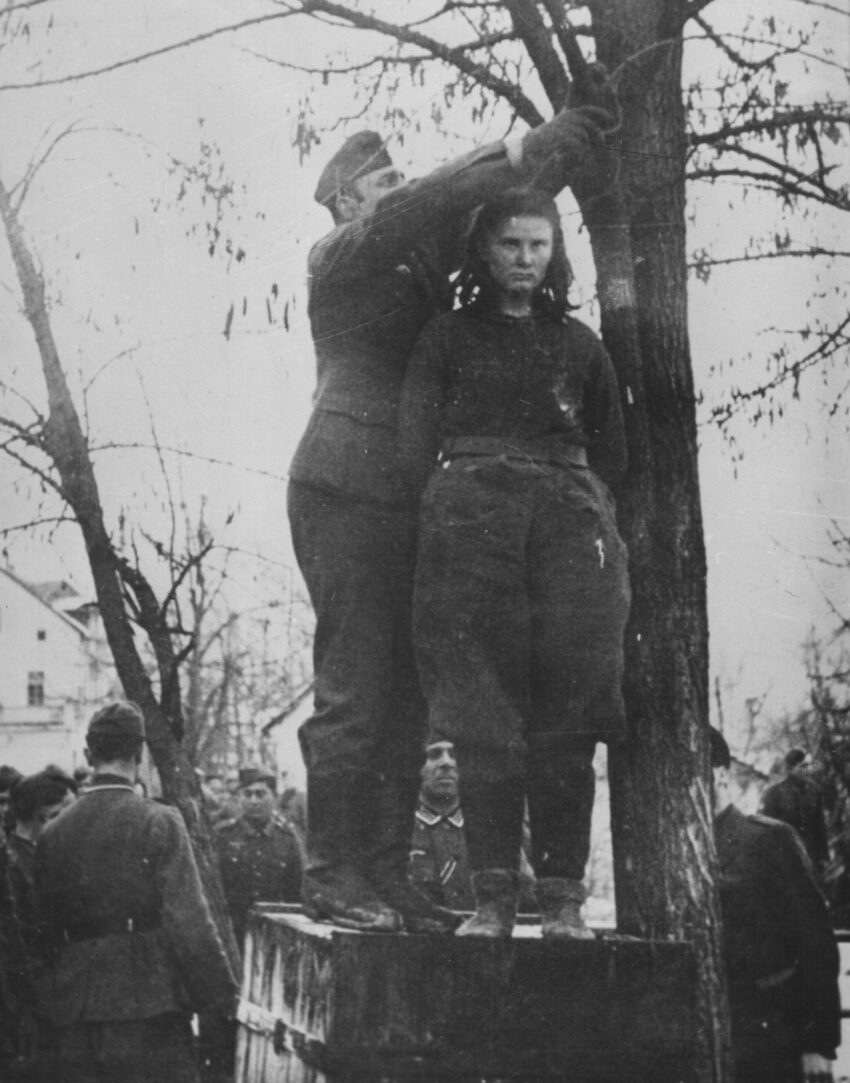
Lepa Radić was a seventeen-year-old member of the Yugoslav resistance during the Second World War. In 1943, after being captured by German forces, she was interrogated and offered her freedom in exchange for the names of other resistance members. She refused.
Born in 1925 in a rural village in what is now Bosnia and Herzegovina, she grew up in a working-class family and attended local schools, where she was known as a serious and capable student. Like many young people in rural Yugoslavia at the time, she divided her days between education and household responsibilities, helping with agricultural labor and family work. Her upbringing emphasized cooperation, endurance, and shared obligation rather than individual advancement.
As a teenager, she became involved in youth and labor organizations that focused on education, mutual aid, and social responsibility. These groups offered structure, discussion, and a sense of purpose at a time when economic hardship and political uncertainty were common. Participation meant meetings, reading, organizing small efforts within the community, and taking responsibility for others. Those who later spoke about her described her as thoughtful and principled, with a strong sense of duty and a seriousness that stood out even among her peers.
During the 1930s, communist ideas began to circulate more openly among workers, students, and youth in the Kingdom of Yugoslavia, despite periodic repression by the state. These ideas emphasized equality, collective responsibility, and resistance to economic exploitation, and they found particular resonance in communities affected by poverty and political marginalization. Youth and labor organizations increasingly drew on this framework to articulate grievances and imagine alternatives to the existing social order, often blending political education with practical mutual aid.
For young people like Lepa Radić, involvement in these movements was not initially revolutionary activity. It meant attending meetings, distributing materials, helping organize educational efforts, and participating in collective projects that addressed immediate needs. Political commitment developed gradually, shaped less by ideology in the abstract than by lived experience within communities that emphasized solidarity over individual survival.
In April 1941, the Axis powers invaded and dismantled the Kingdom of Yugoslavia, rapidly occupying and partitioning the country. Civil administration collapsed, and daily life was reshaped almost immediately by military rule, shortages, reprisals, and the criminalization of political activity. Organizations that had previously operated at the margins were forced underground, and participation in youth, labor, or communist groups became grounds for arrest. For many civilians, including young people already engaged in collective organizing, the distinction between political involvement and resistance effectively disappeared.
Following the occupation, resistance movements emerged across Yugoslavia in response to military rule, political repression, and widespread violence against civilians. Among these, the communist-led Partisan movement developed into a coordinated, multi-ethnic resistance that combined armed struggle with political organization and mutual aid. Resistance was not limited to combat; it depended on communication networks, supply lines, intelligence gathering, and the support of local populations. Participation carried severe risk, as arrests, reprisals, and executions were used routinely to suppress dissent.
Lepa became involved in this resistance as a teenager, drawing on her earlier experience in youth and labor organizations. She served primarily as a courier and organizer, assisting with the movement of messages, supplies, and people between resistance units. This work required discretion, endurance, and constant exposure to danger, as couriers were essential to maintaining coordination and were frequently targeted by occupying forces. Her role placed her within the everyday infrastructure of resistance rather than its public leadership, making her contributions both ordinary and indispensable.
In early 1943, she was captured by German forces during an operation aimed at disrupting Partisan networks in the region. Like many arrests during the occupation, the circumstances were routine rather than exceptional: a sweep, an identification, a removal from circulation. She was detained as part of a broader effort to extract information about resistance activity. At seventeen, she was treated not as a minor, but as an enemy participant within a system designed to dismantle resistance through fear and disclosure.
(Some later accounts describe her capture as occurring during an active engagement, suggesting that she may have been helping cover the escape of others at the time. These versions emphasize courage under fire, but the available contemporary records do not clearly document the circumstances of her arrest in that level of detail. What is certain is that she was detained in the course of anti-Partisan operations and treated as an active participant in the resistance.)
During her detention, she was interrogated by German authorities seeking information about Partisan networks operating in the region. As was common practice, she was offered the possibility of leniency in exchange for cooperation. The terms were explicit: she could preserve her life by providing the names of others involved in resistance activity. She declined to do so, despite repeated questioning and the certainty of the consequences.
Her refusal was not framed as defiance or protest, but as a boundary she would not cross. She did not attempt to negotiate, delay, or redirect blame. The opportunity to survive existed, and she understood it. What she rejected was the condition attached to it. In that moment, the machinery of occupation encountered a limit: a person who would not become a conduit for further harm.
After refusing to cooperate during interrogation, Lepa Radić was sentenced to death. In February 1943, shortly before her execution, she was offered a final opportunity to save her life, while on the gallows, by identifying other members of the resistance. According to later accounts, she rejected this offer publicly, stating: “I am not a traitor of my people. Those whom you ask about will reveal themselves when they succeed in wiping out all you evildoers to the last man.”
This refusal was made with full awareness of the outcome. It was not conditional, strategic, or intended to delay what followed. She did not appeal for mercy or attempt to exchange one life for another. The line she had drawn earlier remained fixed.
After the war, she was posthumously recognized as a People’s Hero of Yugoslavia, and her name was given to schools, streets, and memorials. These honors did not alter the circumstances of her death, nor were they the reason for her refusal. What remains is not a symbol or a slogan, but a documented choice: when offered survival at the cost of others, she declined. The system that sought to turn her into a tool encountered a limit. It did not pass through her.